
 Audible
 Spotify
 Apple Podcasts
 Amazon Music
 PocketCasts
 Podcast Addict
 Deezer
 PlayerFM
 Podchaser
 Overcast
 Castro
 Castbox
 Goodpods
 YouTube
 Episode 65: From Active Income to Passive Wealth: Trevor Thompson Explains Real Estate Investing

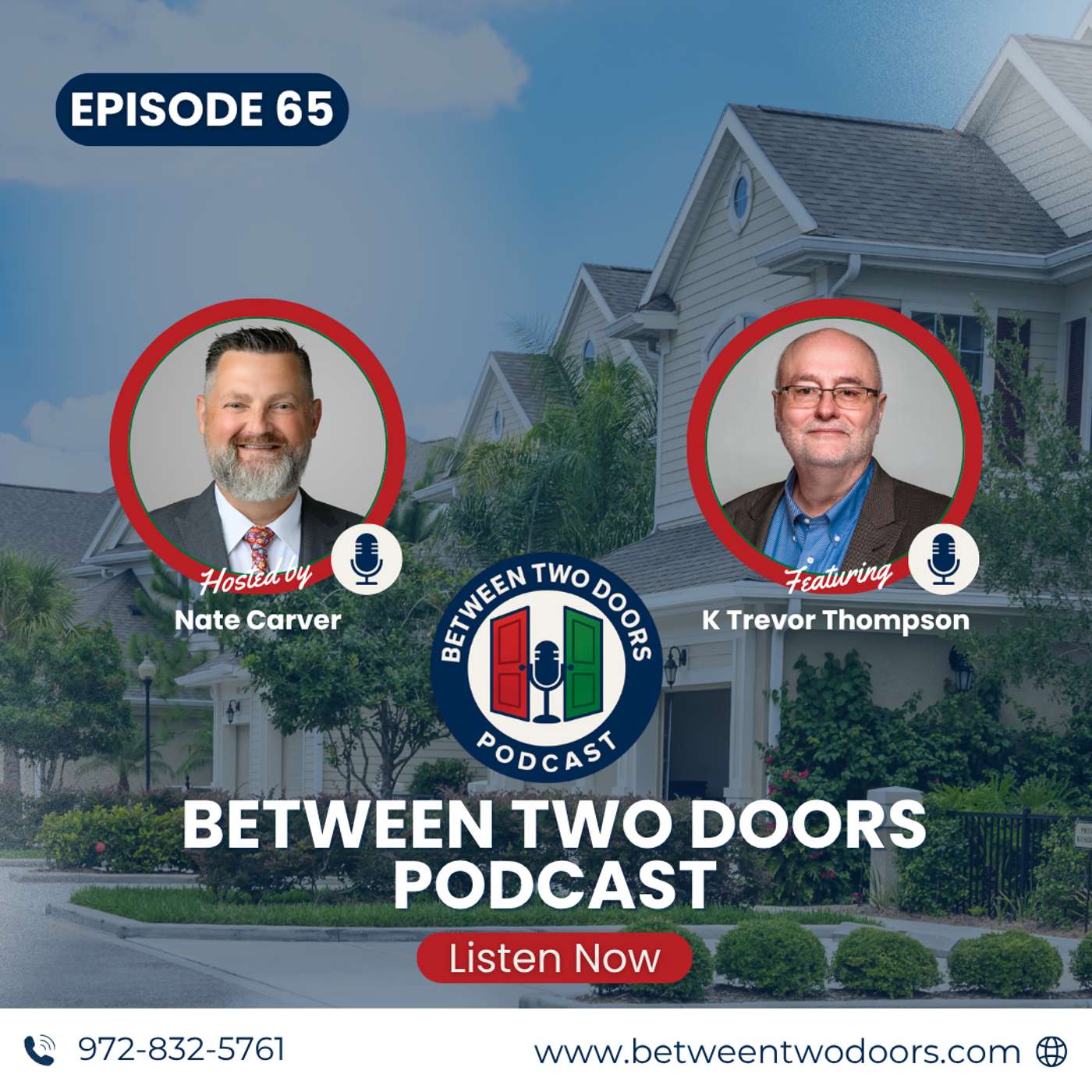
In this episode of Between Two Doors, K Trevor Thompson joins Nate to make commercial real estate investing feel understandable, practical, and possible. From Ripley's Believe It or Not and Guinness World Records to iFly Indoor Skydiving and Massive Capital, Trevor's journey gives listeners a fresh way to think about opportunity, education, and building long-term wealth.
Listen as Trevor explains passive investing, syndications, multifamily deals, commercial real estate, and why the right team matters as much as the right property. Connect with K Trevor Thompson through Massive Capital at https://massive.capital/ and LinkedIn. Between Two Doors features conversations with real estate professionals who help buyers and investors understand the people, places, and strategies behind the move.
If you've ever considered stepping into the commercial, a real estate space.
I've got a podcast for you.
Hey, I'm Nate Carver and welcome
to Between Two Doors.
Hey, everybody.
I make Carver your favorite mortgage guy and host of the between $2 podcast.
Today, we're talking to Trevor Thompson over at Massive Capital.
Hey, Trevor.
I'm excited to be here.
Thanks for having me.
Thank you. Trevor, I'm glad you're here.
This is going to be a pretty exciting, podcast.
I think it's going to be very informative.
And, let's. So let's jump into it.
Tell me a little bit about yourself.
A little background, your personal journey and what got you to
where you're at in the commercial space. Awesome.
So I'm originally from Niagara Falls, Canada.
And I worked in the attractions and entertainment industry,
so I started working for Ripley's Believe It or Not at age 13,
and then Guinness World Records at age 18 for 18 years.
My biggest claim to fame there was we gave Michael Jackson
a lifetime achievement award, and I had lunch with him.
Not very many people can say that.
Then I opened my own Guinness World Records in Orlando, Florida.
But that deal fell through.
Strangely enough, I opened a year round haunted house called Skull Kingdom.
It's no longer there.
And then I got recruited by a company called iFly Indoor Skydiving,
and I opened 46 of 80 locations in the 20 years I was there.
And they let me go, during Covid,
because they were no longer doing any development things.
So I was always interested in real estate,
terrified of toilets, tenants and trash.
So I didn't do it.
A lot of my friends didn't get involved in the single family space.
And then I always believed I had to be a millionaire to invest
in commercial real estate.
And I got a pretty decent payday, started looking into commercial real estate
and found out I was wrong. I don't have to be.
You can invest as a passive investor.
You can invest as little as maybe 25 or $50,000
and fractionally own a piece of a pretty big apartment
complex or another commercial real estate, and I was hooked.
Wow. And you're you're down in the Austin area now?
Yes, sir.
Yes. Right.
Did you open the. I fly up in Dallas.
I did, yeah, there's one in Frisco and one in Fort Worth.
And both of those.
That's the one.
The Frisco one? Yeah, that's the one.
Yeah.
It's number of miles a great. Yeah.
Near the end, a little more exotic.
So I opened Queenstown, New Zealand, Brisbane, Australia, Perth, Melbourne.
A couple in Brazil.
So it was pretty, pretty exciting.
First one on a Royal Caribbean cruise line.
Two airlines. That one.
Oh, wow. Yeah. Yeah. One.
Yeah, I had.
A couple of ribs there, so it's just.
So much fun.
It was a lot of fun.
I went back, I did it again after that.
But, man, there were some pros in there.
Well, good.
Good for you.
So a lot of people want to invest and they never start.
What gave you the confidence to start investing in the commercial space?
You know, so again, I was always interested in real estate.
I had a lot of friends that did real estate deals and did different things,
and I was always interested in it.
So, you know, I again, I thought I had to be wealthy.
I got a pretty good payday.
So I started doing some research and I went to a week, three day weekend
and they talked about this thing called real estate syndications.
And I gotta tell you, a light bulb went on
in my head and I went, where have you been my whole life?
This is exactly what I was looking for.
So what a syndication is an experienced group of real estate investors.
They will buy a property.
They'll take care of buying it.
All of the due diligence.
They'll secure the funding and then they'll operate it.
And then they need passive investors to bring some money in to buy the property.
And then they share the profits with the property.
And this is the most amazing thing that nobody really quite gets.
So let's say I'm going to buy a $10 million property.
Massive capital is and we're going to go get a $7
million loan because we're both 70% loan to value.
So we need $3 million from investors.
But here's the magic.
Those investors can actually own 70% of their $10 million property,
because how we split our deals is 70, 30, 70 to the investors.
So just think of this.
It's mind boggling, right?
We do all of the work.
We need the money to close the deal, but we give you
the biggest share of ownership in exchange for that.
It's so powerful.
So our goal is to normally double your money
every five years, and that comes to you in different ways.
You'll get maybe 20 to 50% of that in cash flow during the five years we own it.
You make the majority of the money at the when we sell the property
and we do this thing called value add, where we'll take an apartment complex,
we'll make it run better and will increase the rents in the units.
So again, on a single family home, if you increase your rent
by $100 a month, the property's not worth anything more.
You just got a little more cash flow on multifamily.
If you had 100 units and you increase the rent by $100 on all
100 units at a 6% cap rate,
you actually created $2 million in value.
So all we have to do is one lever of increasing the rents
by $100 on 100 units that we bought for 10 million,
and that property becomes worth 12 million.
That's called forced depreciation.
And that's what we do.
That's how we create value for our investors.
Now, it will take time to increase all the rents and do that,
get the property going.
But the concept of it is is we buy it, we improve it
and it appreciates over time.
But we force the appreciation by increasing
what they call the net operating income or the income of the property.
Yeah. And it's just it's so powerful.
I got hooked on it.
I've done flips, single family residential flips.
I've done everything from selling the hammers to paint to I've done it all.
And I gave it to me.
I was yeah, yeah.
And then I got to where I was just overseeing and I had GCS and all that.
And then I stepped in to apartment complexes on the commercial side
as passive investor, everything you just spoke about,
it was, you know, they had the renovation cycle.
Yeah.
It was cash flowing.
So I got I got mailbox money every month.
I didn't lift a thing.
I never even I never saw the property.
I saw a picture of.
It is out in Abilene, Texas, and, never saw the property.
Never stepped foot on the property, got mailbox money.
We kept it our the sales, the cycle on it was a five year.
Yeah. Exit strategy.
And they sold it, and I doubled my money.
And I was as a past investor, I too, thought it was a high bar
to get in on that kind of investment.
And I did it for 40 grand.
40 grand in, 80,000 out.
And that was during Covid.
So there was a lot of weird things
happening there, you know, in the real estate world.
And I still made money, which during that time, nothing else.
I had made money.
So I was like, yeah, I was real happy.
How that one, that one worked out for me and I my my record.
You've done 39 commercial. Yes, sir.
Yeah. Fantastic.
And you got in and you started doing this in 2018.
So less than ten years you've done 39.
Yeah. Wonderful.
Plenty of them on the passive side like you.
And then.
Yeah, I'm on the sponsorship side, 19 of those on the sponsorship side.
And those are not all multifamily.
They're not all big.
We just closed on 24 doors in Houston, Texas, two weeks ago.
It was a small property, really nice little niche property
right next to the medical center.
A lot a lot of good way to be able to add value to the property.
Same owner had had it for ten years and he just wanted to keep it for
he didn't care about the ranch.
He bought it at a really good value.
So you know, and then we've done RV parks.
Just closed on my first assisted living almost two months ago.
That's a great new asset class.
And again, all of those massive capital partners
with other partners that are locals or experts in that space, right.
You you want to make sure the people that we did the senior assisted
living with, they've been running one 30 minutes from the same location
for eight years, 100% occupied with a five star Google rating.
That's the kind of people you want your partners because they,
we hired, they're going to come in and run the complex for us.
And they get compensated for it, and they invest in it as well.
And they make the majority of their money being the partner, not the operator.
Wow. There you go.
Hands off.
Investing is what I like about it.
It's so, you know, obviously there's a difference.
You've got you've got the,
you know, the passive investor,
but then your general partners, you're taking on a lot more responsibility.
So as lay person, I mean, it's your comfort level.
I would personally I would say
jump into it in the passive lane.
Oh definitely.
And then even on the active side, we all have a skill set.
So what I do is I'm a capital raiser.
I raise capital for our deal.
Like I mentioned, our partners on the senior assisted living,
their operators, they've been doing it for eight years.
The apartment complex we closed, it was the second unit for the guy
that's running that particular property.
He literally lives ten minutes from the apartment complex.
He's a good local partner, so we always have a team.
And then there's someone who comes on the team that has the experience level,
because lenders will only lend to you if you have somebody with experience.
So that's of capital.
We have about 2000 apartments across the United States.
And then you need somebody with the net worth to be able to sign on a loan.
So there's lots of pieces, that you put together to be able to do this.
Right.
It's it's very different that you're investing in a team.
And you may only have one contact in the team,
but you want to make sure, like,
if I told you that I'm going to run a senior assisted living, you should run.
But if I tell you I got great partners that have been doing it for eight years,
it makes sense. Right?
So who you give your money to?
Earlier when we were chatting, you said you asked a ton of questions.
Find people that are willing to answer your questions,
people that are willing to take that call because you worked hard
for that $40,000 you put in there after tax saved in the bank.
That's a lot of money.
And it took me a long time to get there.
And so you want somebody who did, you know,
wants to help you and answer the questions and make you feel comfortable.
Now, I've got to say, real estate investing can have some risks.
You can lose some money.
So you want to be careful that I don't say, oh, it always happens.
But the goal is, is to invest with people
in good deals, with good teams, in good locations.
And again, Texas, great market.
I mean, so many people come into Texas.
Oh yeah. I so there's some risks to me.
To me.
You know, major lesson you learned in the time that you've been doing this.
You you go.
Back the biggest lesson that everybody learned,
nobody in a million years thought this thing called Covid
would come, and interest rates would go from three and a half to 8.5%.
So I had invested in a deal that didn't have fixed rate debt,
and they got in trouble because there it like tripled
the payment they had to make and they just couldn't do it.
So that deal got in trouble.
So some things I never thought of before in a million years
was the importance of things like fixed rate debt.
You know, a lot of different things.
And again, insurance been huge.
I got a friend who had an apartment complex,
and he was paying $400 a door for his insurance.
It went up to $1,600 a door.
He had 300 apartments.
Tell me that can't kill your numbers now.
It came back down a little bit
because Texas went a bit crazy on the insurance side.
Some other it's come down, but things like that.
And again, who didn't own that we would have this crazy interest rates.
And so the real estate goes in cycles.
So we've been in a cycle with some pain for the last couple of years,
but we're now at this new buying opportunity, right?
That, it's a great time to buy.
Interest rates are still pretty stable.
You know, we we have a deals coming up and we're about 5.38%.
And we actually
one of the cool things on commercial real estate is interest only, period.
So this particular deal has five years interest
only on a fixed ten year note with a 30 year amortization.
It's that's really solid that, and that finding that
kind of debt became so much more valuable when you got that upheaval.
Wow. So tell me,
let's talk a little bit about massive capital where you're at.
What what kind of what do you think sets you apart from other real estate
investment grade? Yeah. So I refer to Massive capital.
We're an entrepreneurial syndicator.
So we also have a mastermind program where we teach people
how to do the syndication side, and then we partner with them.
So all of those last few deals I mentioned,
those are folks that have gone through our mastermind program.
They found deals.
And so we underwrite like, like 50 deals a week.
We probably make 3 to 5 offers a week.
And we probably close one deal a month or get one deal a month.
Like, we, we kiss a lot of frogs to find the prince.
And so we're constantly learning, growing.
And what happens is when you that active people start seeking you out.
Right.
So brokers these deals come from brokers.
So brokers will say okay, well these guys seem really active and
oh this is the deal. That's right for them.
Or sometimes we pass on a deal and then the deal comes back around
because, you know, they wanted the seller just wanted too much money.
Just same thing in your houses, right?
Eventually. Right.
You got to sell and nobody's buying.
What do you got to do. You got to lower the price.
Right.
What kind of assets is massive capital pursuing.
So we're doing multifamily, senior assisted
living, RV parks, mobile home parks and storage.
In fact, I was on a call with a guy today.
They're looking at buying sober living facilities,
kind of a whole different type of asset class.
And those those are asset classes that it's kind of like a hybrid.
Right?
So people that, that, that need halfway houses or need care come in and there's
medical programs that will pay for them to come in and get the counseling.
And they need a bed to stay while they're getting the counseling.
So I've never done a sober living.
So I was actually just before this on a call with the guy learning about
how does it work and how do they find the people.
And, and, and this one is actually
we would buy it and a third party would operate it.
So the third party, the operator is specialized
at doing the service, but they don't want to own the real estate.
So someone listening today
and they maybe they want to step into the passive side of this.
What would be the best, smartest first step?
The first step, first of all, is to find somebody, you know, like and trust, right?
Find somebody.
I mean, that's why I agree to do these podcasts
so that hopefully somebody says, hey, Trevor seems like an all right guy.
And they reach out to me on LinkedIn or somewhere
else, and they say, hey, I was interested.
I also do the second Tuesday, I do an educational webinar.
And in fact, this coming Tuesday or June the 69th,
what is it, the second Tuesday, trying to remember the day.
I'm talking about the difference between single family, June the 9th,
and multifamily,
you know, because because again, I'm not saying don't do single family.
I'm just saying understand the differences between the two.
Yeah. Single family can often be.
I always tell people, you can make a lot of money, but
you're buying a part time job and you're assuming all of the risks, right?
If if a tenant moves out, who pays the mortgage?
You do it.
The tenant trashes the place, who fixes it?
You do, where on multifamily,
someone else takes care of it, and there's scale.
Wow. Yeah, absolutely.
So you've got a mission.
This is what really what intrigued me about you.
I was reading up on this, and I reached out to you.
Tell me about your mission to help.
Yeah. So, you know, it was funny.
So when I first started this, I thought, goodness me, I'm 58 years old,
and nobody told me ever about this.
Real estate syndication and passively investing in commercial.
I'm going to tell a thousand people.
And then I listen to Mr.
Cardone Tanks audible book and went, well, you're a wimp, Trevor.
Move it to ten.
And then actually, my original mentorship program
I joined merged in with Massive Capital and the leader of that group said Trevor,
with all of our network,
because they they owned the they had they run the biggest Ria in Central Texas.
They've got 5000 people in the other program.
He said, we're going to increase Trevor's goal.
There were 100,000 people.
So 100,000 is a bit hairy.
Audacious goal.
I thought I was being pretty bold that one and then went to ten.
But I thought, you know, I'm going to embrace it.
And again, it doesn't mean you invested with me.
It just means you heard this podcast and I shifted
your mindset, opened your mind to do something different.
Right.
Because everything teaches us go to work,
go around that monopoly board, collect that paycheck, put your money in a 401 K,
let somebody you don't know invest your money in not hard assets.
And that's the right way to do life.
And I don't think it's the right way to do life.
Right.
You should have some mixture.
I'm saying get rid of all of your stocks.
I did eventually, because I'm kind of all in.
But, you know, invest in some hard assets that can really grow your capital.
So what
does what is financial independence personally mean to you?
So financial independence means
that you can choose what to do with your time.
You're not forced to choose what you can do with your time,
because you need to sell your time to somebody else to make money.
So that's what it means to me.
So me, for example, I'm doing all of this
and I'm still making money doing it on the deals and doing things.
But for me, I can control my time and I can spend my whole time
dedicated to my mission of making sure people
learn about commercial real estate to other people.
It can have a million different things, right?
Leaving things security for their family.
You know, freedom.
Lot of people want to leave their job.
And I actually tell people, don't leave your job until your passive income
is three times your salary.
Because you want to keep that money compounding, right?
If you think about this.
Yeah, if you invested 100 and grew to 200 and reinvested that, it grows to four,
reinvested, it grows to a 1.6, 3.2
million and 25 years from one $100,000.
Compounding. You're not pulling it out to live on it.
And then once you do that and you're a multimillionaire,
you can have any choice that you want to make
to to do what you want to do.
In the time that you've been doing this and with your mission to help 100,000,
are there any people along
the way that stand out that you that
that this has dramatically changed their life?
Yeah, definitely.
Especially on the you know, they just.
Like you said, once you start getting that money
and once the deal goes full cycle, it's like,
wow, you know, because again,
are there flukes in the stock market where people go crazy?
Of course there is.
But the far minimum right there, you know, the fact
that you could double your money in five years, it's pretty tremendous.
And my biggest life changing event.
So I invested in a deal and in 20 months they tripled my money.
Now that was crazy.
Not going to happen on a regular basis.
They they hit everything, right? Right.
They sold before Covid.
They sold before the interest rates went up.
They implemented their business plan flawlessly.
You know, so but that was a pretty, pretty
I gave them $50,000 in 20 months later, they gave me 152.
Nice. Yeah.
So out on the other side of my computer screen
had big board and it's my vision board, and I've got some pretty big goals.
And,
you know,
you know, personal growth stuff.
I can go get a book and I can read and devour that.
But there's some things in life I want to be a part of and in fund.
And then there's things in life that I want to, celebrate with.
Like my sailboat.
I got a little model sailboat where I'm going with this
out of front of a vision board.
I look at that, and I know there's a dollar amounts, and this stuff
costs money.
And I'm like, how do I get there?
You know, there's my career as a mortgage lender, and, that's, that's
that is one silo, if you will, of how I'm going to get there.
But my investment portfolio in the commercial space is a big piece of that.
That's all I say. That is my retirement.
And so it's building that out and having that kind of residual income.
I, I'm
all in on I love being a passive investor.
I just love it.
I mean, I can
the bar, the guys that I've invested with and call me anytime
they'll talk to me about it, they'll answering any dumb question
I come up with and that, you know, they
they answer my calls or text messages and,
it's it's been a wild journey and I haven't had a break.
Sweat.
Yeah. Yeah.
My vision board is kind of interesting.
And again, I'm not even.
So I have two places,
one places in Arizona looking at a mountain that has a sunset
and looking at an ocean
in Florida that has a sunrise.
And I literally have pictures of
and I'm not talking buying, you know, Jeff Bezos house.
I'm talking about just buying some nice place
that the sun comes up over the ocean and a place in Arizona.
And I like the mountains in Arizona is so beautiful, like Sedona.
If you've ever been there, it's
it's it's like God came down and touched the mountains.
It's like an amazing, you know, but I want a sunset.
And so, yeah, very specific.
And, you know, and it doesn't have to it can be a three bedroom, a little house.
It's okay. But that's on my vision board.
And my wife put on there to take care she animals and so that we,
you know, we find some care for for the humane society and animals.
Okay. Yeah.
What, any
myths that constantly come to mind or get
you get asked to dispel in the, in this space.
You know, so I think the biggest myth is the lie we've all been taught
to, you know, to go and go to work,
trade time for money, invest in your retirement plan,
let somebody else control all of your money
and hope that you're going to have enough when you go to retire.
That myth is just kind of not real, right?
And until you really can put your money to work for you
so you're no longer trading time for money, right?
As a kid, I loved playing monopoly, and I knew
the people that bought the houses and turned them in hotels won.
And I'll be honest, I became an adult and kept
going around the board collecting my paycheck.
Now we got bought out by private equity, got a pretty big payday,
but it still didn't set me up to where I would consider myself financially free.
I still need to take that money and then grow that money.
And that's why I tell people, you know, you should be taking
10 to 20% of your money and putting that money to work.
And then once you have at least double your income, then you can start living off
of that money.
We're keeping some of it there for you,
you know, and there's so many crazy ways you can do things.
So, for example, you can buy real estate
and then you can 1031 into a property where you do it
tax free and then you die and your heirs inherited it.
The stepped up value.
I mean, where else could you make $10 million with a profit?
Nobody pays tax on it.
It's crazy.
Or put it into a Roth retirement plan.
And it grows tax free, not tax deferred.
It's crazy.
It's crazy. Yeah.
You know, so that deal I talked about taking 100,000 turned into $3 million.
Well, could you imagine if that was tax free?
Tax free? That's crazy.
And the you. Yeah.
The government lets it be tax free.
If you turn it into a Roth and just invest it for 25 years
and let it keep growing, you can take it out tax free.
That's insane.
Like taxes are our biggest bill.
It is you know, so in the lending space.
So when I'm writing loans
but some borrowers will have some tax free income, like Social Security.
Yeah. VA disability.
As a lender, I'm allowed to set up 125%.
That's the essentially what someone who is paying
taxes on income that makes that gives them a parity.
So $3 million times 125%.
You know that's your tax advantage.
And not bad.
Not bad.
It's not that the older I get I'm like, well I got to do to hang on to what I got
but make it grow and not, you know, I'm the pay.
I'm gonna pay what I have to pay in taxes.
But, we're not a penny more.
Yeah.
So, so what motivates you?
Let's say, you know,
we got we're talking about financial freedom, impact your legacy.
Is there something else that motivates you?
You know, I think just sharing what I learned, right?
Sharing to me that that's what motivates me.
That's why I set this mission of a thousand.
Went to ten, not 100,000.
Again, I realized that's a bit of a fanciful mission.
But again, if a couple hundred people listen to your podcast
and 20 of them change their mind, they may never even reach out to me.
And that's that's okay.
As long as they change their mindset and they think,
how can I put my money to work for me so I can make a decision
at some point, what I'm going to do?
Yeah.
Is there a minimum,
down payment or down payment?
Is there a minimum, investment opportunity or.
Normally minimums are 50. Okay.
And we at times we've let people come in for less, but our normal minimum is 50.
Yeah.
Good boy.
And there's this room.
I mean, there's so much room for people to come into this.
Yeah.
And I love it.
What would you tell yourself if you could go back and tell younger?
You get get in quicker earlier.
There are very, you know.
Yeah.
Warren Buffett
says that somebody's sitting in a tree because somebody planted it under a tree.
Somebody planted it 20 years ago.
And the next best time to plant a tree is today.
Yeah.
So, you know, the earlier start, I have never met a real estate investor.
Says I wish I'd waited.
No, they all say I wish I had started earlier.
I do, I didn't start those 58.
Imagine if I started when I was 28.
Goodness.
I'd probably be looking at that sunrise.
You probably would be.
Yeah.
Well,
go to the too.
So yeah.
You know, again, not it's just fantastic.
I don't know.
So someone, you know, this conversation with you, I feel inspired.
I've enjoyed it.
I will tell me, is there something you hope someone talking to you about
capital investments,
that they're going to take away from having met you?
I mean, I'm just hoping that they understand
how achievable it is for the average person.
And then you will never understand it all, but get with somebody
who will answer your questions. Right.
Just like you said earlier.
You know, again, I remember the the first deal I invested
in, I said $100,000 and I, I tell you what,
I stayed up all night wondering what in the world have I done?
Am I crazy?
I sent $100,000 to a guy I met a month ago.
I'm still, in fact, he's partner of Massive Capital.
So it worked out, I guess.
Yeah.
He he's who I work with on a regular basis and,
you know, but, I thought, what am I doing in my crazy,
but I just want to make sure that people feel comfortable, right?
That when you invest with people that, you know, like, and trust,
you know, that's a good way
to put your money to work for you, so you won't have to keep working for it.
Yeah, well, I just I love the space.
I mean, the ability to get in.
I remember when I first started looking at real estate,
I thought I had to have 100,000 plus 200,000, you know,
to be able to do a home, the residential side.
And then, you know, I thought you had to have lots
of stacks of cash for commercial space in,
you know, the different avenues for commercial investing.
It's a low bar financially.
You know, you can say that you can get there.
And there's, there's it's a wonderful opportunity.
And a lot of people don't know this either, too.
If you've left a job and you've got an old retirement plan,
you can move that over to self-directed and then use those funds as well.
Yeah.
Super powerful way.
And if it's if you didn't do a Roth, at least gross tax deferred,
but if you converted into a Roth, it grows tax free.
That's awesome.
Questions I'm going to not run out of time here.
You mentioned one book.
You mentioned an influencer in your life.
What's book, a book, a podcast or a mentor
that, that has heavily influenced you?
Yeah.
So I mentioned Grant Cardone to listen to, audible
and then follow it up with Be Obsessed or Be Average.
It could be obsessed or be average is actually the fulfillment of ten acts.
A lot of people don't know that.
So I have listened to it in audible and listen to in that order.
So and I actually listened to it 2 to 3 times a year,
just kind of the beginning of the year to reset my mindset.
So and then be obsessed or be average.
I'm also, you know, big, big Jim Collins good degree
and all of those, different, different books and things like that.
You know, so, so definitely been big influences in Stephen Covey.
The seven Habits of Highly Effective Person changed my life 30 years ago
and still does.
Yeah.
That's the one.
Every high profile.
Yeah.
Successful person in the business world that I know always reference is that one.
Yeah.
It's an amazing book because it's it puts complicated things
into so simple and understandable.
Right.
You know.
Yeah.
He's just so just it's such an amazing book.
Such a powerful man. Yeah.
All right.
One habit or routine that has made the biggest difference in your success.
So I think it's it's living with passion.
So I've been really fortunate.
Every job I've had has been like super cool, right?
Like Guinness World Records I fly, and I never even thought
raising doing real estate investing would be super exciting.
But I'm if you can't tell.
I mean, I've been I'm excited, I love it.
And and so it's just been everything I've done
has been, you know, like I say, I always give the gift of flight, right?
That, you know, the joy of flight to everybody,
with the Guinness World Records and Ripley's in the same thing,
making sure people had great experiences, you know, good fun family times
and, you know, and then again, on the commercial real estate side, too,
when we buy properties, we make it better for average working folks.
Right.
You know, the unfortunately, buying a home now is out of the grasp of most people.
And so let's give them nice places to live in apartments where there's,
you know, owners that care about them. Yeah.
What's next for you?
I don't know if you can see three, five years in the future.
You know, I, I can't see myself doing anything
but what I'm doing now till I get, you know, till, I just I at some point,
eventually, I might run out of energy with it, but I'm loving it.
Yeah.
It's fun.
Yeah.
It's a the mortgage space, the lending space.
Real estate in at large I love it.
It's a wonderful place to be.
I would have never guessed
in my own journey in life that this is where I would end up.
And I'm like, I wish I got here sooner.
It's my wife says to me, all I do is spend all day sitting in the office
talking on zoom to people, you know, have a yeah and praise the here's what I do.
And that's why I always accept and reach out to people about,
you know, doing these shows because I want to share.
Good.
I love it.
And, I think it I hope I hope we've reached,
you know, if you're listening to this, reach out to Trevor.
Speaking of, where can people connect with you?
So LinkedIn is the best place, and you gotta remember the key.
My legal name is Keith.
I was never called Keith.
But my legal name is Kate Trevor Thompson.
When I worked at 16, I worked
for a guy that used his first initial, and I thought that was pretty cool.
And so I was buying a car, and I had documents that said
Keith and documents that said Trevor and I became Kate Trevor.
So find me on LinkedIn, Kay, Trevor Thompson,
and just say Cy and Nathan's podcast and happy to talk with you.
All right.
I'll, I'll put the links down below.
There is a QR code if you're watching this or listening to this.
There's a QR code here as well.
If someone's,
listening and you want to start building a financial freedom
through a real estate first action step, should they take
this week would be.
To get educated somewhere.
So, you know,
I have a YouTube channel that has the seven steps of passive investing.
I talk a lot of basic information on my YouTube channel.
You know, you just want to start getting educated in this space, right?
Super important that you understand
the deal.
All right. Final final question.
When opportunity knocks and on someone's door,
what do you believe is the difference between the people who will open it
and the people that don't?
So I think the adventurous people always open it.
I've never not opened a door.
And I've never jump not jump through it, like just, oh, there's an open door.
Let's go. Yeah. Figure it out later.
Nice.
Well, okay.
Trevor.
Thank you, thank you.
Everybody, I'll get the links down below.
And, if y'all want to reach out to, Kay Trevor at massive Capital,
for for more information and, and jump into some investment
opportunities in the commercial space, that will be available.
As always, I'm your favorite mortgage guy.
If you're looking for lending
in the commercial or, residential space, I'm available.
My link contact Sam information down below.
Okay. Trevor.
Thank you. Thank you, thank you.
Enjoy this.
This was this was very educational for me, too.
And, I've done it.
And so, folks, it's a great opportunity.
Great place to put money, and invest in
your future.